

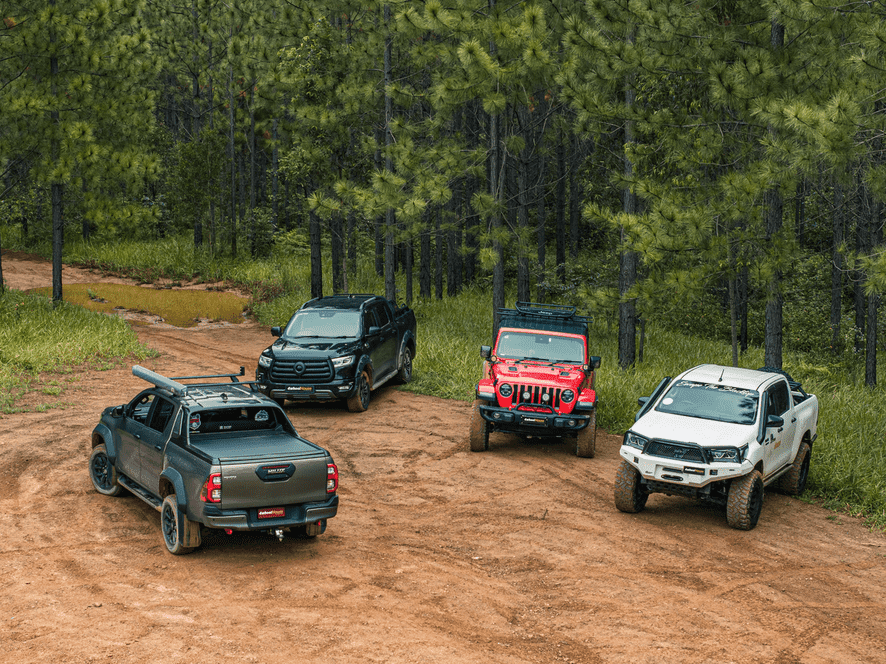
"Will they fit" is one of the most searched tyre questions in the country, and it's a fair question, because the answer genuinely isn't the same for every vehicle. A 265/70R17 to a 33 inch tyre might be a non-event on one ute and a rubbing, grinding mess on another, depending on what's already under the guard.
This guide walks through what actually decides clearance, the difference between a small step up and a genuine size jump, and which parts fix which problem. It doesn't cover the legal side in detail, that's a separate question with its own state-by-state rules, and we've linked out to the guides that cover it properly.
Most 4WDs can step up to a 31 or 32 inch tyre with no suspension changes, and a 33 with minor trimming. Beyond that, a 35 inch tyre or bigger generally needs a proper lift kit, a diff drop kit to correct the CV angle on IFS vehicles, and wheel spacers or guard flares to clear the tyre without rubbing or breaching the guard line.
- Wheel diameter and width both matter, but it's clearance at full steering lock and full suspension compression that actually decides whether a tyre rubs, not just the static measurement.
- A lift kit buys height, it doesn't fix the CV joint angle problem on independent front suspension utes and wagons. That's a separate job for a diff drop kit.
- Wheel spacers push the tyre outward for clearance, but they increase scrub radius and bearing load, so they're a fine tuning tool, not the primary fix for a big size jump.
- Guard coverage is a legal question as much as a fitment one. Tyres sitting outside the guard line is a defect risk covered in our ute overhang and lift kit legality guides.
- Going bigger changes your speedo accuracy, your gearing feel and your fuel use. Budget for those trade-offs rather than being caught out by them.
- If you're anywhere near the edge of what your vehicle can take, get a proper fitment check before you buy rather than after.
What actually decides whether a bigger tyre fits
Three things matter, and none of them is just "how big is the tyre." First, static clearance: does it clear the guard, the sway bar, the bash plate and the mudflap sitting still. Second, dynamic clearance at full steering lock: this is where most rubbing actually happens, on the inner guard liner or the sway bar as the front wheels turn. Third, clearance at full suspension compression, which is where a bump or a dip in the track can bring the tyre up into the guard even if it looked fine in the driveway.
A tyre that's too tall for your gearing is one problem. A tyre that's too tall for your guard is a different, more immediate one. Most of the actual rubbing complaints on forums come down to the second and third points, not the first.
The small step: 31s to 33s
This is where most owners land, and it's genuinely achievable on a lot of stock utes and wagons with modest work. A pair of coil or strut spacers lifts the vehicle 25 to 50mm, enough to clear a modest size increase without touching spring rate or ride quality. It's the cheapest real fix available, and it's a sensible first step if you're not chasing a full touring build.
What spacers don't do: add articulation, improve load carrying, or fix a CV angle problem. They're a clearance tool, not a suspension upgrade. If you're also adding a bar, a canopy or touring gear, a proper lift kit with the right spring rate for the extra weight is the better long term option, our suspension lift kit buying guide covers that decision in full.
Going bigger: 35s and up
A 35 inch tyre or larger is a different job. You're generally into a full lift kit for the height, and on any independent front suspension ute or wagon, a diff drop kit as well. Here's why the diff drop matters: lifting the body raises the diff housing relative to the wheel hub, which steepens the angle the front CV shafts run at. Run that angle too steep for too long and you get vibration under load, clicking on full lock, and CV boots that tear early. A diff drop kit lowers the diff back toward its original angle relative to the hub, correcting the geometry rather than just adding height on top of a bad angle.
Leaf sprung rear ends and solid front axles (most wagons, older utes) don't have this problem, the whole axle moves together, so there's no CV angle to correct. It's specifically an IFS ute and wagon issue.
Wheel spacers: what they fix and what they don't
A wheel spacer pushes the wheel and tyre outward from the hub, which buys clearance from the sway bar, the coil spring and inner guard components without changing ride height at all. It's a genuinely useful fine tuning tool once you've already got the height sorted and you're a few millimetres short of clean clearance.
What it isn't is a primary fix for a big tyre jump. Pushing the wheel out increases the scrub radius (the distance between the tyre's contact patch and the steering axis), which adds load through the wheel bearings and steering components, and it widens your overall track, which can push the tyre outside the guard line even as it clears the suspension components. Use a genuinely hub centric spacer, torqued to spec, and treat it as the last few millimetres of the fix rather than the whole solution.
Guards, flares and staying legal
Once you've solved clearance, the last question is coverage: does the tyre still sit inside the guard line, or does it need a flare to stay covered. This is where fitment and legality overlap, a tyre that clears everything mechanically but pokes outside the guard is still a defect risk in every state.
Guard flares extend the bodywork out to cover a wider stance, whether that's from a wheel spacer, a wider tyre, or both. They're a straightforward fix once you know you need one, the harder part is knowing the exact rule for your state, which is genuinely different from jurisdiction to jurisdiction. Our ute overhang laws guide and state-by-state lift kit legality guide cover the actual limits, this guide is deliberately about what fits, not what's legal.
What changes once you go bigger
A bigger tyre isn't a free upgrade, it changes real, measurable things about how the vehicle drives and what it costs to run.
Speedo and odometer: a bigger rolling diameter means more ground covered per wheel revolution, so your speedo reads slow compared to actual road speed. Moving from a stock 265/70R17 to a 33 inch tyre typically reads 3 to 5 percent slow at highway speed, and more on a bigger jump again. This isn't just an inconvenience, it affects cruise control accuracy and can affect a speeding defence if you're ever questioned on speed.
Gearing: a taller tyre effectively lengthens every gear, which can leave a naturally aspirated engine feeling flat off the line and working harder to maintain highway speed. Some builds re-gear the diffs to compensate, most don't bother unless the tyre jump is large.
Fuel use and brakes: more unsprung rotating mass takes more energy to accelerate and more braking force to slow down, so expect a genuine, if moderate, increase in fuel consumption and a bit more work for your brake system, particularly towing.
| Tyre size target | Typical mod needed | IFS diff drop needed |
|---|---|---|
| Up to 31 inch | Usually none to minor trim | Rarely |
| 32 to 33 inch | Coil/strut spacers or mild lift | Sometimes |
| 34 inch | 2 to 3 inch lift kit, spacers, flares | Usually |
| 35 inch and up | Lift kit, diff drop, spacers, flares | Yes, on IFS |
Ballpark ranges only, the exact figure depends on your specific vehicle, wheel offset and existing tyre size. Confirm against your setup before buying.
Not sure if they'll actually fit?
Send us your vehicle and the tyre size you're chasing, and we'll tell you exactly what's needed to get there without the guesswork.
Get a Fitment Check →Clearance figures and typical tyre size ceilings will vary by vehicle, wheel offset, existing tyre size and how the vehicle is loaded. This guide is reviewed periodically by the 4wheelhouse technical team. For fitment advice matched to your exact vehicle and target tyre size, get in touch with our team before you buy.